
Belugas are curious, social, and very vocal, and some wild belugas will swim up to boats and kayaks, which is why they are known as friendly whales. But "friendly" is a human label. Belugas are wild animals, and whether they feel anything like friendship toward people cannot be measured. The best way to enjoy them is from a respectful distance, without feeding, touching, or chasing.
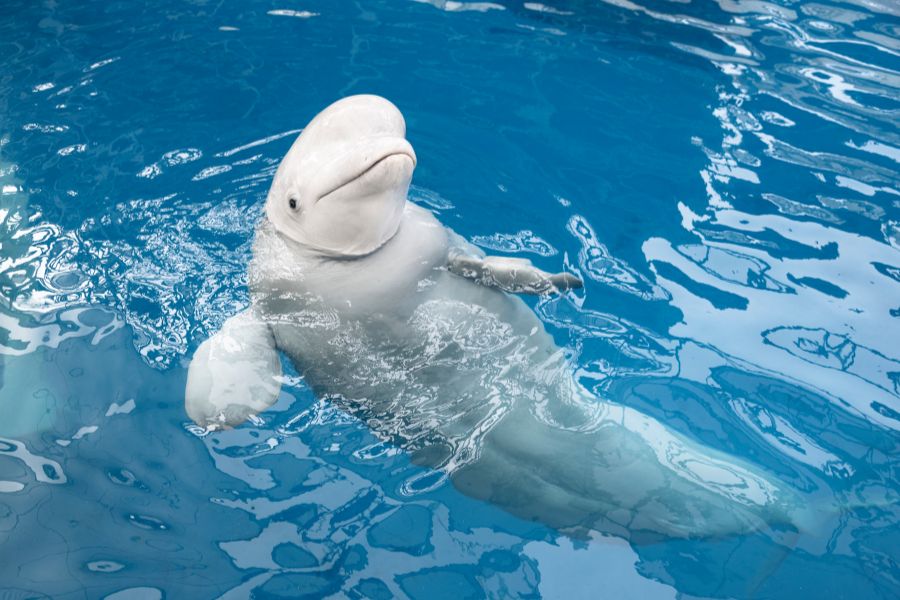
Why belugas look so friendly
Several features of beluga anatomy and behavior add to the impression:
- A round, flexible forehead. The melon, the fatty bulge on the head, is more flexible in belugas than in many whales and changes shape when they make sounds, according to SeaWorld.
- A mouthline that curves upward. It looks like a smile. That look is a product of how the mouth is built, not a sign of mood.
- A neck that bends. Unlike most whales, belugas do not have fused neck vertebrae, so they can nod and turn their heads from side to side.
- Constant chatter. Belugas are nicknamed "sea canaries" for their whistles, calls, and clicks. See whale communication for how whales use sound.
- Social lives. Groups usually number from a few whales to around ten, and individual belugas move between groups, according to NOAA Fisheries. In summer, hundreds can gather in estuaries.
Where belugas come close to people
Churchill, Manitoba. Belugas gather in the Churchill River estuary from early July to late August. Travel Manitoba says more than 55,000 belugas migrate through Hudson Bay near Churchill in those months, and visitors can see them from boats, kayaks, and paddleboards. One local tour company, Sea North Tours, says some belugas swim close behind boats to enjoy the bubbles from the propeller. That habit is risky for the whales, because propellers can injure or kill them.
Hvaldimir, Norway. In 2019, a beluga started approaching fishing boats in Norwegian waters. He wore a tight harness with a camera mount and markings referring to equipment from St. Petersburg, which led to speculation that he had escaped from captivity in Russia. He lived alone, stayed close to people, and reportedly played fetch. He also carried scars from boat strikes, according to Mongabay.
Hvaldimir was found dead near Risavika, Norway, on August 31, 2024. Norwegian investigators concluded that a bacterial infection probably killed him. A stick lodged between his teeth and the base of his tongue may have made it harder to eat and raised the infection risk. Police saw no sign of illegal killing and did not open an investigation, although animal rights groups dispute the findings, Stars and Stripes reported.
Hvaldimir's story is a poor guide to normal beluga behavior. Most belugas live in groups, in remote Arctic waters, far from boats.
Why do some belugas approach people?
Scientists have not pinned down a single reason. Curiosity is the usual explanation, and bubbles from propellers are part of it for some belugas. Food is another factor. According to NOAA, feeding marine mammals can make them lose their wariness of people and boats, change their natural feeding and migration habits, and become aggressive, which raises the risk of boat strikes, fishing gear entanglement, and harm from frustrated people.
Do belugas bond with people?
Belugas are intelligent. They can learn new sounds, they live in social groups, and some show signs of recognizing themselves in a mirror (see How Smart Are Beluga Whales?). That does not tell us what a beluga feels when it swims beside a kayak. A beluga approaching a boat is best read as curiosity or habit, not affection. It also does not mean the animal wants to be touched.
How to watch belugas without harming them
The rules for keeping a distance differ by country and by place:
| Where | Minimum distance | Notes |
|---|---|---|
| U.S. waters (NOAA) | 100 yards (300 feet) | Limit watching to 30 minutes, slow down, hold a steady course |
| Most Canadian waters | 100 meters | 200 meters if the whales are resting or have a calf |
| Narrow parts of the Churchill and Seal river estuaries | 50 meters | Elsewhere in those areas, 100 meters |
| St. Lawrence Estuary and Saguenay River (endangered belugas) | 400 meters | Keep a constant speed and do not stop |
Beyond distance, the rules are consistent:
- Do not feed belugas.
- Do not touch them or try to swim with them. Fisheries and Oceans Canada counts swimming with or interacting with a marine mammal as disturbance, and NOAA does not support or authorize touching or swimming with wild whales.
- Do not separate a mother from her calf, or trap whales between a boat and the shore.
- Avoid flying drones near belugas unless you hold the right permit.
For the safety side of close encounters, see Are Beluga Whales Dangerous?. For the basics on size, range, and conservation, see the beluga whale guide.