
Polar bears are bigger than grizzlies. A typical adult male polar bear weighs 775 to 1,300 pounds (350 to 600 kg), while grizzly males in the lower 48 states usually weigh about 400 to 600 pounds. The gap shrinks for large coastal brown bears in Alaska, which can come close to a polar bear's weight, but the heaviest wild bears ever recorded were polar bears.
Polar bear vs grizzly: size at a glance
| — | Polar bear | Grizzly bear (lower 48) |
|---|---|---|
| Adult male weight | 775-1,300 lb (350-600 kg) | About 400-600 lb (180-270 kg) |
| Adult female weight | 330-650 lb (150-290 kg) | About 250-350 lb (110-160 kg) |
| Height on all fours | 3.3-5 ft (1-1.5 m) at the shoulder | 3.5-4.5 ft (1.1-1.4 m) at the shoulder hump |
| Standing on hind legs | Large males over 10 ft (3 m) | More than 8 ft (2.4 m) |
| Largest on record | About 1,700 lb (800 kg) estimated for one wild male, and a disputed 1960 record bear heavier still | Brown bears overall up to about 1,000 lb; Kodiak males up to 1,400 lb |
| Body shape | Long neck, small head, no shoulder hump | Broad head, prominent shoulder hump |
| Diet | Mostly seals and their blubber | Omnivore: plants, roots, fish, insects, mammals |
Weights come from Polar Bears International, the U.S. Fish and Wildlife Service and Montana Fish, Wildlife and Parks. They are ranges, and any one bear's weight shifts with the season, its food supply and where it lives.
What counts as a grizzly?
Grizzlies are brown bears. Alaska's wildlife agency treats brown and grizzly bears as one species, and uses "brown bear" for coastal animals and "grizzly" for inland ones. In the lower 48 states the grizzly is the subspecies Ursus arctos horribilis.
That matters for size, because brown bears vary more than polar bears do. The National Park Service gives a range of 200 to 1,000 pounds for brown bears overall, depending on sex, place and season. Inland and lower-48 grizzlies sit at the light end. Coastal bears with access to salmon grow larger. Kodiak bears, a brown bear subspecies on islands in southwest Alaska, weigh 600 to 1,400 pounds for males, according to the Fish and Wildlife Service, which overlaps with the typical polar bear range. See polar bear vs Kodiak bear for that comparison.
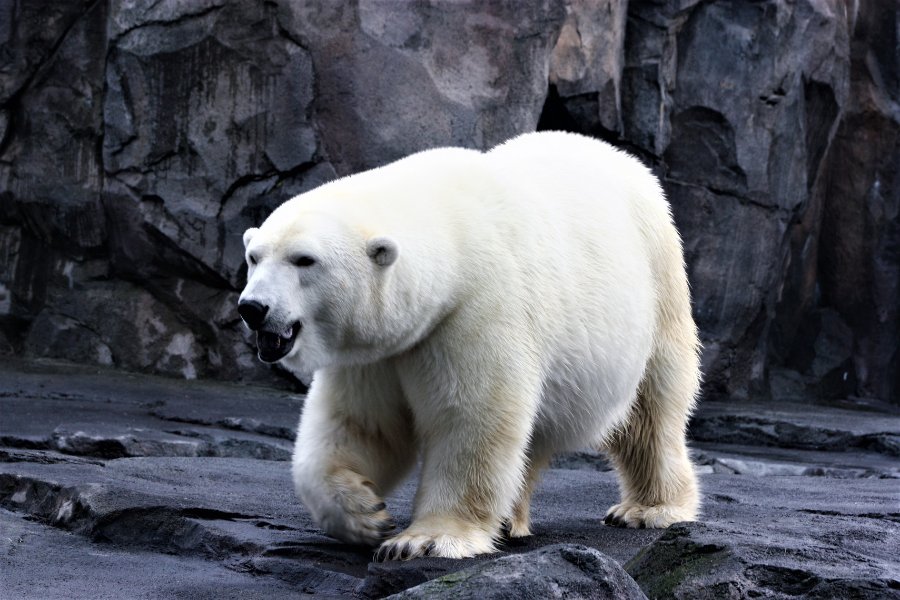
How big are polar bears?
Polar bears are the largest living bear species on average, though large Kodiak bears rival them. Adult males can stand over 10 feet (3 m) on their hind legs, and their paws can be up to 30 cm (nearly 12 inches) across. Females are much smaller, and in some regions they run larger than the usual range.
Polar Bears International mentions one male estimated at about 800 kg (1,700 lb). The heaviest bear on record is a polar bear shot in 1960 in the Chukchi Sea west of Kotzebue, Alaska. It is often reported at 2,209 pounds (1,002 kg), but Guinness World Records lists an estimate of about 900 kg (1,984 lb) and notes that the figures have been disputed. Treat that record as approximate.
How big are grizzlies?
A lower-48 grizzly stands 3.5 to 4.5 feet at the shoulder hump on all fours and can rear up to more than 8 feet. Males average roughly 400 to 600 pounds and females 250 to 350. Very large brown bears elsewhere can reach almost 9 feet upright. The shoulder hump is the easiest way to tell a brown bear from a polar bear.
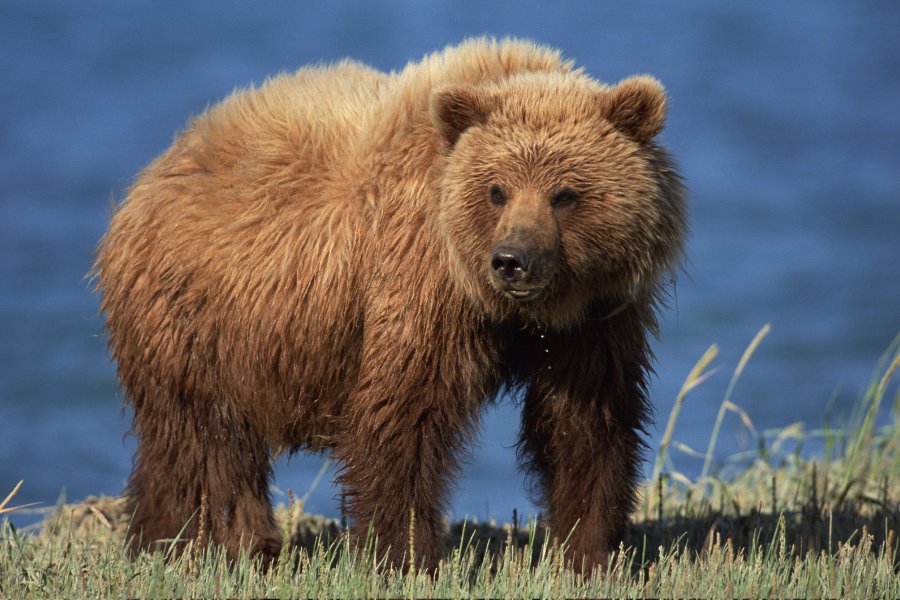
Why are polar bears bigger?
Diet is probably the main reason. Polar bears live mainly on seals, and the fat-rich blubber is what they go for first. Grizzlies eat whatever is available, and body size follows food: inland and lower-48 grizzlies are much lighter than coastal Alaskan brown bears.
Size also has costs. Polar Bears International notes that adult males can overheat quickly when running, because their two fur layers prevent nearly all heat loss. Grizzlies are fast sprinters, with agency sources giving short-burst speeds of about 35 to 40 mph.
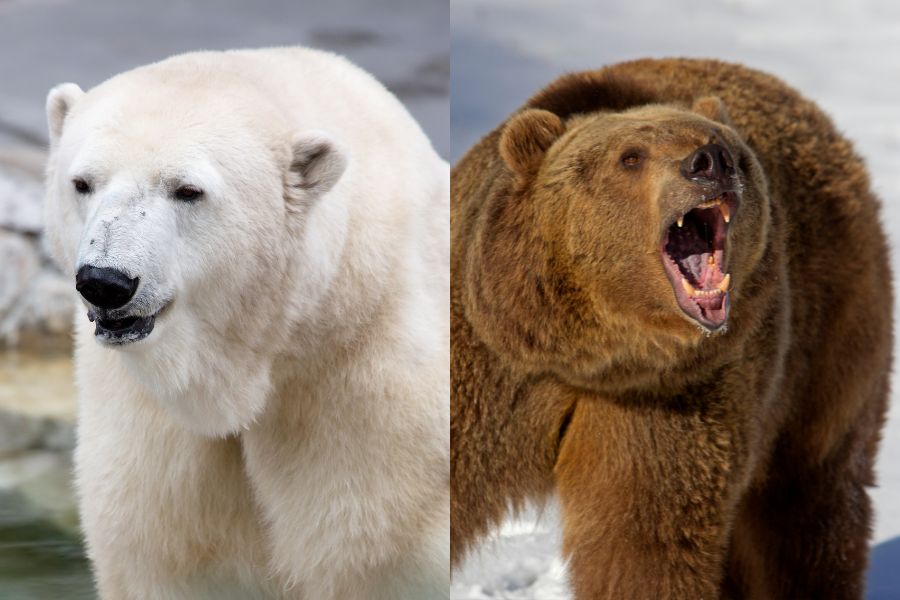
Do polar bears and grizzlies ever meet?
Rarely. Their ranges overlap in some places in the Arctic, and warming is increasing that overlap as grizzlies move north. A study of 819 wild grizzly and polar bears found only eight hybrids, about 1 percent of the samples. "Who would win" is speculation, because the two species almost never meet.
Which is more dangerous?
Both can kill a person, and neither should be approached. Polar bears live in remote Arctic areas with few people, while grizzlies share country with many hikers and campers. In bear country, follow the local wildlife agency's advice.