
Sand tiger sharks and tiger sharks are unrelated species that only share part of a name. The tiger shark is the larger, more dangerous animal: it grows to 10 to 14 feet, has dark stripes when young, and is second only to the great white in recorded attacks on people. The sand tiger is smaller, with long jagged-looking teeth, has no fatal bites on record, and is critically endangered worldwide.
Sand Tiger Shark vs Tiger Shark at a Glance
| Feature | Sand Tiger Shark | Tiger Shark |
|---|---|---|
| Scientific name | Carcharias taurus | Galeocerdo cuvier |
| Order and family | Lamniformes, Odontaspididae | Carcharhiniformes, Carcharhinidae |
| Typical length | 4 to 9 feet; up to about 10.5 feet | 10 to 14 feet; up to about 18 feet |
| Weight | Up to about 350 pounds | Typically 850 to 1,400 pounds; the largest over 2,000 pounds |
| Appearance | Stout, light brown to gray, scattered reddish-brown spots, long narrow jagged teeth | Blunt snout, dark stripes that fade with age, broad notched teeth with serrated edges |
| Young per litter | 2 | About 10 to 80 |
| Gestation | About 9 to 12 months | 13 to 16 months |
| Unprovoked bites on humans (ISAF) | 36, none fatal | 142, 39 fatal |
| IUCN status | Critically Endangered | Near Threatened |
Names and Classification

The two sharks belong to different orders. The sand tiger (Carcharias taurus) is a mackerel shark in the family Odontaspididae. The tiger shark (Galeocerdo cuvier) is a ground shark in the family Carcharhinidae, which also includes bull sharks and blacktips.
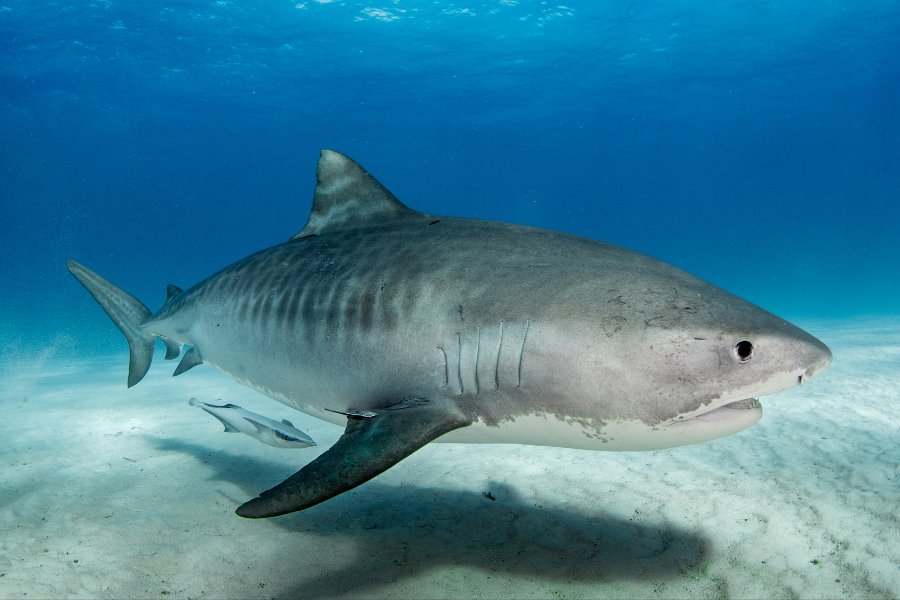
Sand tigers have other names around the world. They are called grey nurse sharks in Australia and spotted raggedtooth sharks in South Africa. The tiger shark is named for the vertical stripes that develop as juvenile blotches fuse, and the Florida Museum notes that these markings fade in mature adults.
Physical Characteristics
Size, Weight, and Lifespan
Sand tiger shark:
- Length: Average adults are 4 to 9 feet. The largest are about 10.5 feet (320 cm) for females and 9.9 feet for males.
- Weight: The maximum published weight is about 350 pounds (158.8 kg).
- Lifespan: Age estimates from vertebrae reach 30 to 35 years, and the maximum age is at least 40 years. The oldest aquarium shark lived 24 years.
Tiger shark:
- Length: Typically 10 to 14 feet. The largest confirmed are about 18 feet (5.5 meters).
- Weight: Typically 850 to 1,400 pounds, and the largest are estimated at more than 2,000 pounds.
- Lifespan: FishBase lists a maximum reported age of 50 years.
Color, Teeth, and Fins
The sand tiger is light brown or greenish-gray above and grayish white below, often with scattered reddish or brown spots. Its teeth are long and narrow with small side cusps, which gives its mouth a jagged look. It has two dorsal fins of similar size.
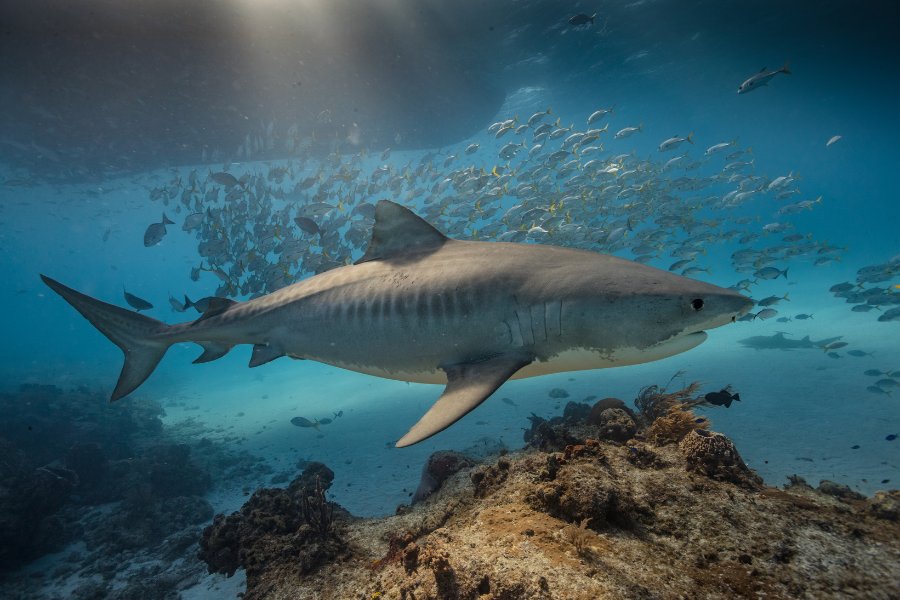
The tiger shark is dark gray above and pale below, with the stripes that give it its name. Its teeth are large, curved, and finely serrated, with a deep notch on the outer edge. That shape suits cutting through tough prey, and sea turtles are part of its diet. The first dorsal fin is broad and the second is much smaller, with a ridge running along the back between them.
Distribution and Habitat
Sand tiger shark: Found in most warm seas except the eastern Pacific. In the western Atlantic its range runs from the Gulf of Maine to Argentina. It also occurs from the Mediterranean to South Africa, and from Australia to Japan. It lives mostly inshore, in surf zones, shallow bays, and around reefs, and it is found from about 6 to 626 feet deep. It usually stays near the bottom and migrates with the seasons.
Tiger shark: Found in temperate and tropical waters worldwide except the Mediterranean. In the western Atlantic it ranges from Massachusetts to Uruguay, including the Gulf of Mexico and the Caribbean. It uses open ocean and shallow coastal waters, and it often visits murky areas such as river estuaries, harbors, and inlets. It has been recorded at depths of several hundred meters.
Diet and Hunting

Sand Tiger Shark
Sand tigers eat mostly bony fish such as herring, bluefish, flatfish, eels, and mullet, along with rays, squid, crabs, lobsters, and smaller sharks. They sometimes hunt in groups that herd schools of fish.
The species has an unusual way of managing buoyancy. It has no swim bladder, so it swims to the surface, gulps air into its stomach, and uses it to hover motionless in the water.
Tiger Shark
Tiger sharks eat a much broader range of animals, including sea turtles, rays, other sharks, bony fish, seabirds, dolphins, squid, and crustaceans. They also scavenge carrion and have been found with garbage and other human-made objects in their stomachs. They feed mainly at night.
Reproduction
Both sharks give birth to live young, but their strategies are very different.
A pregnant sand tiger produces two pups, one from each uterus, usually every other year. Gestation is roughly 9 to 12 months, and pups are about 39 inches long at birth. Before birth, the largest embryo in each uterus eats its smaller siblings and unfertilized eggs. This is called adelphophagy, or intrauterine cannibalism. Because so few young are born, sand tiger populations recover very slowly.
Tiger sharks are ovoviviparous. The eggs hatch inside the mother, and the pups are born alive after 13 to 16 months. Litters range from about 10 to 80 pups.
Danger to Humans
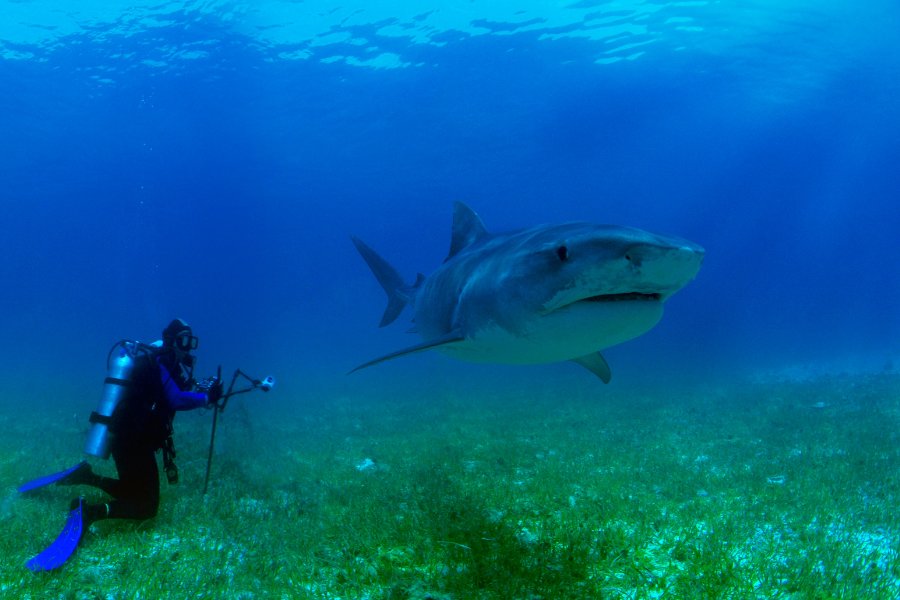
The International Shark Attack File (ISAF) at the Florida Museum counts 142 unprovoked tiger shark bites on humans, 39 of them fatal. Only the white shark has more, with 351. Tiger sharks are one of the "Big Three" species most often involved in serious bites. They often use murky coastal waters, harbors, and estuaries, which overlap with places where people swim and surf. For context, the ISAF confirmed 65 unprovoked shark bites on humans worldwide in 2025, nine of them fatal, across all species.
For sand tigers, the ISAF lists 36 unprovoked bites and no fatalities. According to the Florida Museum, bites have occurred mostly on spearfishers carrying speared fish. FishBase adds that sand tigers have bitten swimmers and can be aggressive toward divers carrying speared fish, so they are best given space despite their reputation for being docile.
The ISAF warns that its species counts should be used with caution. Victims rarely get a good look at the shark, and the table leans toward species that are easy to identify. White, tiger, and sand tiger sharks are nearly always identified correctly.
Conservation Status
Sand tiger shark: The IUCN Red List moved the sand tiger from Vulnerable to Critically Endangered in its 2021 assessment. The assessors suspect a global population reduction of more than 80% over three generations (about 74 years), caused by exploitation. A sand tiger female has only two pups every other year, so the species cannot rebuild quickly. According to the New York State DEC, NOAA made it a prohibited species in U.S. federal waters in 1997, and an Atlantic States Marine Fisheries Commission order banned it in state waters from Maine to Florida in 2008.
Tiger shark: Listed as Near Threatened. The IUCN says the species does not face a high risk of extinction at present, but local declines are documented. A 2019 study of Queensland, Australia, estimated that tiger shark numbers had fallen by 71% along that coastline, and the researchers named overfishing, including catches in Queensland's shark control program, as the likely cause. The drop was steeper in the south than in tropical waters.
For more detail, see the tiger shark profile and the great white shark profile.
Sources
- Sand tiger shark species profile (Florida Museum)
- Tiger shark species profile (Florida Museum)
- Unprovoked shark attacks by species (International Shark Attack File, Florida Museum)
- Sand tiger shark species status assessment (New York State DEC)
- Decline in tiger shark population defies expectations (Phys.org, Griffith University study)