
The blue whale is much bigger than the sperm whale. A blue whale can reach about 110 feet and 330,000 pounds, while the largest male sperm whales reach about 52 feet and 45 tons. The sperm whale is the largest toothed whale and a far deeper diver, and the blue whale is the largest animal known to have lived.

The two eat very different food. Sperm whales hunt squid and fish in the deep sea with their teeth, while blue whales filter krill from the water with baleen plates.
Sperm Whale vs Blue Whale: Key Differences
| Feature | Sperm whale | Blue whale |
|---|---|---|
| Whale type | Toothed whale | Baleen whale |
| Scientific name | Physeter macrocephalus | Balaenoptera musculus |
| Length | Females about 40 ft, males up to 52 ft | about 80-100 ft, up to about 110 ft |
| Weight | Females about 15 tons, males up to 45 tons | up to about 330,000 lb (165 tons) |
| Food | Squid, deep-water fish, sharks, skates | Krill |
| Mouth | 20-26 large teeth on each side of the lower jaw | Baleen plates, no teeth |
| Typical dives | Routinely 2,000+ ft for about 45 minutes | Shallower: 600 ft and up to 16 minutes in one tag study |
| Lifespan | Up to about 60-70 years | About 80-90 years |
| Calf at birth | about 13 ft | about 23 ft |
| Gestation | 14-16 months | 10-12 months |
| Calving interval | About every 5-7 years | About every 2-3 years |
| IUCN status | Vulnerable | Endangered |
Size and Appearance
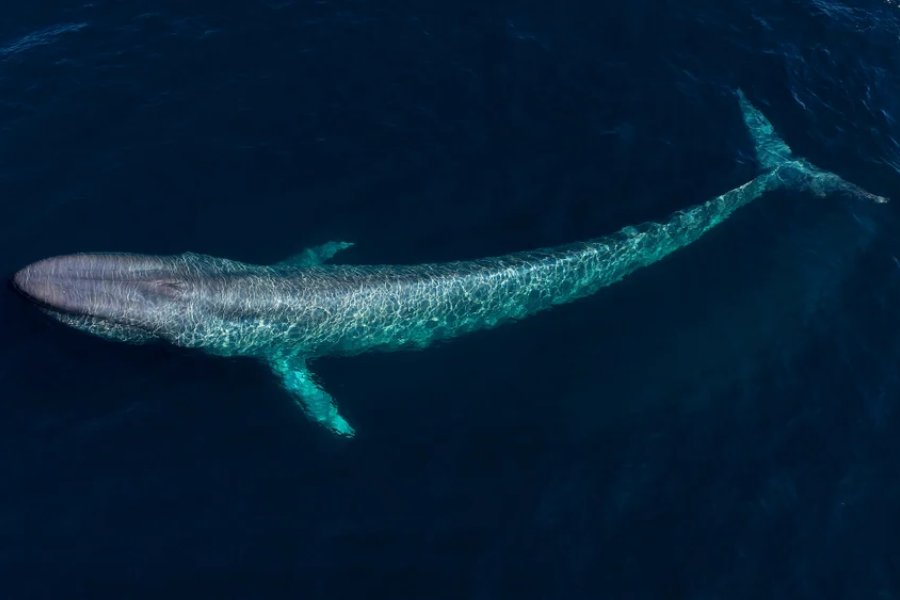
NOAA Fisheries lists blue whales at up to about 110 feet and 330,000 pounds. The heaviest one ever weighed was a 1947 female at 190 metric tons (418,878 pounds). A large male sperm whale is therefore about half the length of a big blue whale. See the blue whale size comparison for more detail.
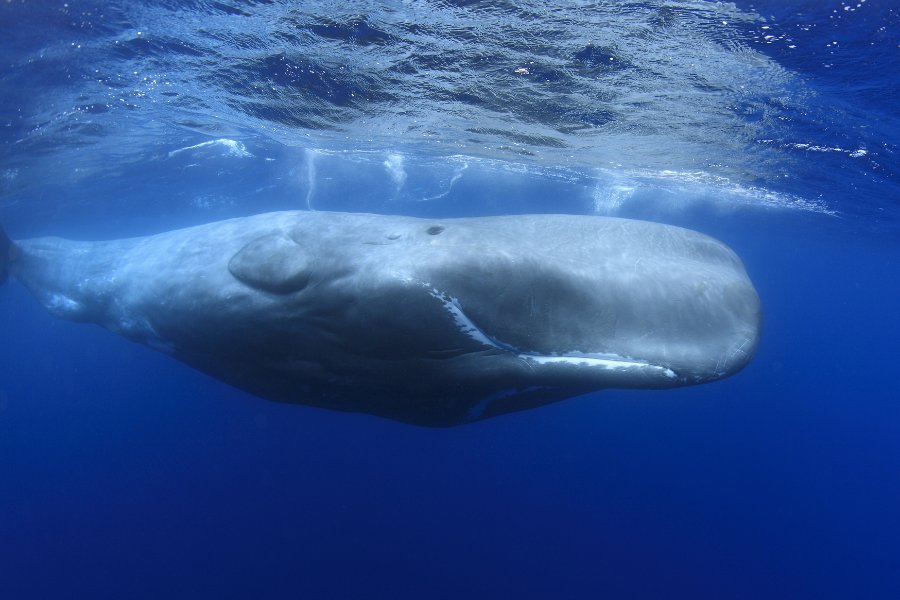
The sperm whale is easy to recognize. Its enormous, squarish head makes up about one-third of its body length, and the skin is a wrinkled gray-brown. The head holds the spermaceti organ, a sac of waxy oil that gives the species its name. Research suggests the organ helps focus the whale's sound.
Sperm whales have the largest brain of any animal, roughly 15 pounds in an average adult and more than five times the size of a human brain. The blue whale looks very different: a long, slim, mottled blue-gray body with a small dorsal fin and a wide head.
Diving
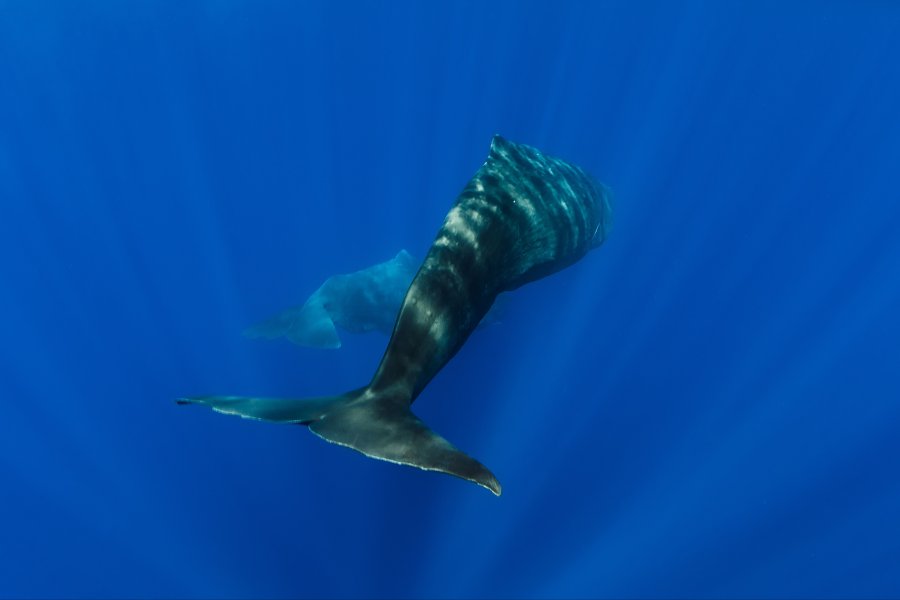
Sperm whales are among the deepest-diving mammals. NOAA says their dives routinely reach 2,000 feet and can last 45 minutes. A tagging study of one sperm whale in the Caribbean recorded deep dives that averaged about 990 meters (3,250 feet) and 44 minutes, with the deepest at 1,330 meters (about 4,400 feet) and the longest at 65 minutes. Reports of dives much deeper than that exist, but they are less well documented.
Blue whales dive far shallower, because krill swarms are nearer the surface. In a 2019 study of a tagged blue whale off California, feeding dives reached 184 meters (about 600 feet) and lasted up to 16.5 minutes. Deeper blue whale dives of a few hundred meters have been reported.
Feeding
Sperm whales hunt in the dark, mostly for squid. NOAA lists squid, sharks, skates, and deep-water fish, and says a sperm whale eats about 3 to 3.5 percent of its body weight each day. Giant squid are part of the diet, though most squid they eat are far smaller.
Blue whales eat almost nothing but krill. NOAA says the largest blue whales may eat up to 6 tons a day, and a 2021 study of tagged whales estimated up to 16 metric tons on a peak feeding day.
Sounds
Both whales are loud, in different ways.
- Sperm whale: makes short, directional clicks for echolocation and also uses patterned clicks called codas to communicate with other whales. Researchers measured clicks up to 236 decibels (relative to 1 micropascal), the loudest sound recorded from any animal.
- Blue whale: makes very low-frequency calls, mostly between about 15 and 40 hertz. A calling Antarctic blue whale is estimated at roughly 189 underwater decibels. NOAA says the sounds may travel up to 1,000 miles.
Underwater decibels use a different reference than airborne sound, so these numbers cannot be compared directly with sounds like jet engines or thunder.
Reproduction and Life Cycle
A sperm whale pregnancy lasts 14 to 16 months and produces one calf about 13 feet long. Females calve roughly every five to seven years, and calves nurse for several years. Females mature around age 9. Males reach puberty between about 10 and 20 years but often do not breed until their late twenties.
Blue whales carry a calf for 10 to 12 months, and the newborn is about 23 feet long. Females calve every 2 to 3 years on average, and the calf is weaned at about 6 to 7 months. Maturity comes at 5 to 15 years.
NOAA lists a sperm whale lifespan of up to 60 years, though other sources say 70 or more. Blue whales are estimated to live about 80 to 90 years.
Social Life
Female sperm whales and their young live in family groups, while mature males tend to roam on their own. Blue whales are usually seen alone or in pairs.
Sperm whales also sleep in an unusual way. See sperm whales sleep vertically for details.
Whaling and Conservation
Sperm whales were hunted for their oil and for the waxy spermaceti. Blue whales were hunted too, mainly in the 20th century. Today both are protected under the US Endangered Species Act and the Marine Mammal Protection Act, and the International Whaling Commission's ban on commercial whaling took effect in 1986.
- Sperm whale: rated Vulnerable on the IUCN Red List, a status confirmed in the 2025 update. NOAA says numbers are likely increasing but gives no global total. Threats include vessel strikes, entanglement in fishing gear, ocean noise, marine debris, oil spills, and contaminants.
- Blue whale: rated Endangered. A 2018 IUCN assessment estimated 5,000 to 15,000 mature whales and 10,000 to 25,000 in total, compared with at least 140,000 mature whales in 1926. NOAA names vessel strikes and entanglement as the primary threats.
Sperm whales and blue whales both have a predator in the killer whale. A 2022 study documented orcas killing blue whales off Western Australia. The two whales eat different food, so they do not compete for prey.
Are Either Dangerous to People?
Neither whale hunts people. Blue whales are not known to attack humans, as explained in are blue whales dangerous. Sperm whales have teeth but feed on deep-sea prey far from people; see are sperm whales dangerous for details. As with any large whale, keep your distance. NOAA advises at least 100 yards.