
No, seahorses are not dangerous to people. They have no teeth, venom, or sting, and they feed only on tiny animals such as small crustaceans. The real risks run the other way: handling harms seahorses, and keeping them in an aquarium can expose you to germs in the tank water.
Anatomy and Behavior
Seahorses are fish in the family Syngnathidae, along with pipefish and seadragons. Project Seahorse counts about 45 species along tropical and temperate coasts worldwide.
They range from Satomi's pygmy seahorse, at a little over half an inch, to the big-belly seahorse, at up to about 14 inches (35 cm).
Some key features explain why they are harmless:
- A toothless snout. Their jaws are fused into a tube, and the Florida Museum describes the snout working like a pipette to suck in shrimp, copepods, and similar small prey.
- A grasping tail. It wraps around seagrass, coral, or mangrove roots so the fish can hold its position.
- Bony armor instead of scales. Skin stretches over rings of bony plates. Camouflage and this armor are their main protection.
- A soft dorsal fin. It has no spines, and it beats rapidly to push the fish along.
Seahorses are also poor swimmers. The dwarf seahorse is often cited as the slowest fish in the world, with a top speed of about 5 feet per hour. They wait for food to drift close, then strike with a quick snap of the head.
Seahorses do make noise. They produce clicks and snaps by rubbing bony parts of the head, mainly while feeding and courting.
So Are Seahorses Dangerous to Humans?
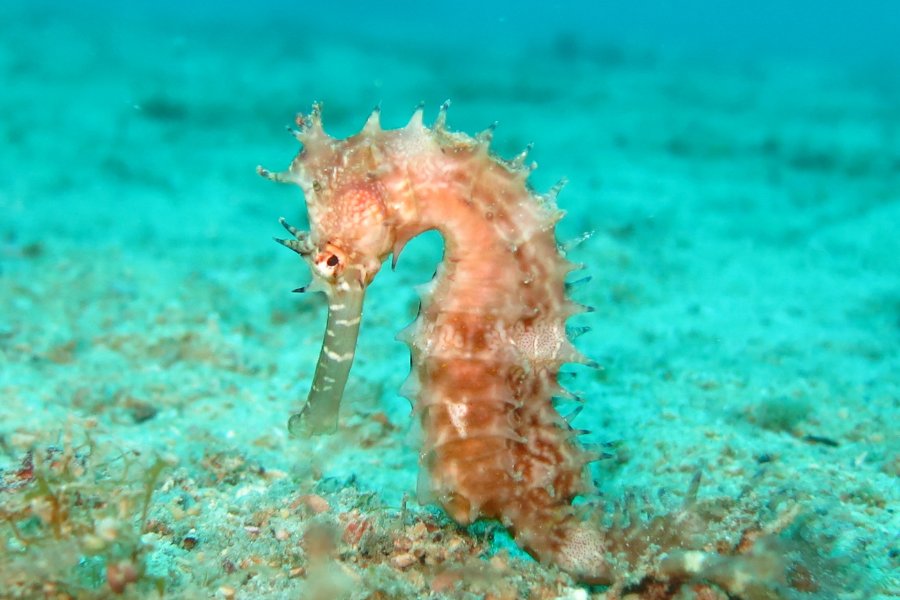
No. Species profiles and conservation groups describe seahorses as prey, as traded animals, and as species at risk, not as a hazard to people. Here is how they measure up against the things that make marine animals dangerous.
| Possible danger | Seahorses | Why |
|---|---|---|
| Bite | No meaningful risk | No teeth, and a tiny tube-shaped mouth built for suction |
| Sting or venom | None | No stinger or venom glands |
| Poison from touch | None known | No toxic skin secretions are described in species profiles |
| Attack | None known | Slow, small, and focused on tiny prey |
| Sharp edges | Minor | Some species have a spiny coronet or body knobs |
| Germs | Possible in aquariums | Tank water and fish can carry bacteria that infect people |
Dangers of Touching or Holding a Seahorse
The main reason to keep your hands off a wild seahorse is the seahorse's safety. They should not be handled for casual reasons, even gently.
Harm to the Seahorse
Grabbing a seahorse stresses it and can injure it. Pulling one off its holdfast can also leave it exposed, since these slow swimmers depend on staying put and blending in. Divers and snorkelers should watch from a distance and leave them where they are. Some places also protect seahorses by law, so check local rules.
Germs and Infection
Germs can move between fish and people through water and broken skin. The CDC says pet fish can spread harmful germs and that tank water and items in tanks can be contaminated. One known example is fish tank granuloma, a skin infection caused by Mycobacterium marinum.
According to Washington State University's animal care program, people can catch that bacterium from infected fish or contaminated aquarium water, usually through a cut or scrape. It typically causes ulcers or nodules on the hands. Fish that carry it can look healthy for a long time. These sources refer to fish generally, not seahorses specifically.
Scrapes From Spines
The Florida Museum notes that the coronet on a seahorse's head can have sharp edges or spines, and some species are spinier than others. These could scratch skin if someone squeezed the animal, but they have no venom. Clean any scrape, particularly if it happened in the ocean or in a tank, since seawater and aquarium water can carry bacteria. See a doctor if redness, swelling, pain, or discharge develops.
Myths and Misconceptions
Myth: Seahorses Sting
False. Seahorses have no stingers or venom. Any prick from handling one would come from a bony edge, not a toxin.
Myth: Seahorses Use Their Snouts to Attack
False, though they are carnivores. They eat small crustaceans and other small invertebrates, and they suck them up whole. Their snouts cannot bite, pierce, or draw blood, so nothing about their feeding can harm a person.
Fact: Male Seahorses Give Birth
This one sounds like a myth, but it is true. As Camilla Whittington of the University of Sydney explains, the female places her eggs in the male's pouch and he fertilizes them. He then carries the developing young and releases them as tiny, fully formed seahorses.
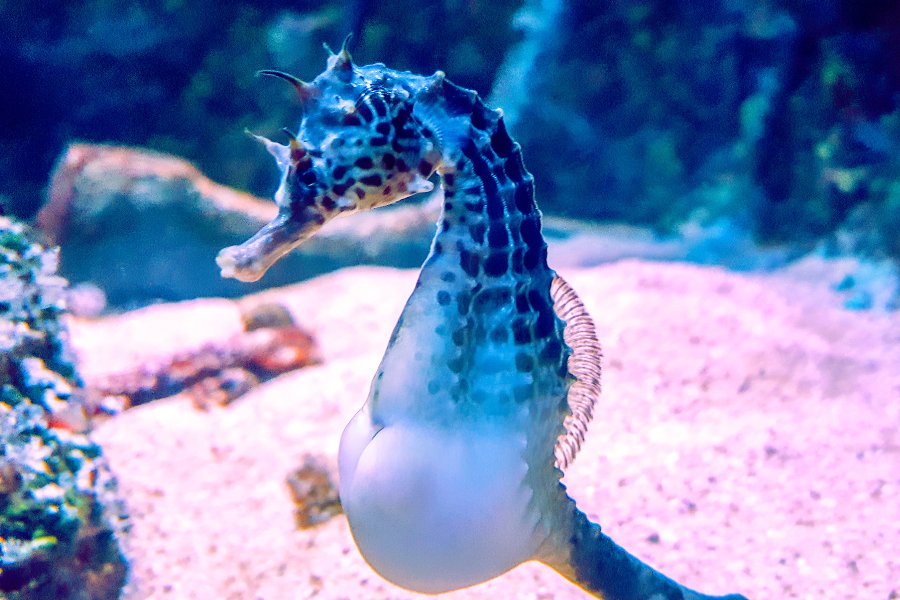
In the lined seahorse, this takes about 20 to 21 days, and a brood starts with 250 to 650 eggs. Some species can release more than 1,000 young at once. Birth is not aggressive or dangerous. The father bends his body back and forth until the young come out, and they receive no care after that.
Dangers When Kept as Pets
Seahorses are not dangerous pets, but they can be difficult ones, and tank hygiene matters.
Keeping Yourself Safe
- Wash your hands with soap and running water after touching fish, tank water, or equipment. The CDC calls this the best way to prevent illness.
- Do not put your hands in the tank if you have cuts or scrapes. Wear waterproof gloves for tank maintenance.
- If you are pregnant, have a weakened immune system, or have a chronic illness, talk to a doctor before working with aquarium fish, as Washington State's guidance advises.
- See a doctor about any sore, nodule, or swelling on your hands that does not heal, and mention your aquarium.
Difficulty Meeting Their Needs
Seahorses have specific needs for water quality, food, tank mates, and places to hold on. Many eat small live or frozen foods, and they are slow feeders, so fast fish can outcompete them. Lifespan depends on the species. The dwarf seahorse commonly lives about a year and rarely past two.
Cost and Sourcing
Seahorse keeping generally needs a dedicated tank and a steady supply of suitable food, and those costs add up. Look for captive-bred animals from reputable sellers rather than wild-caught ones. All seahorse species are regulated in international trade under CITES.
Injury Risks in the Tank
Strong filter intakes can trap small fish, so shield them. Rough décor and aggressive tank mates can also cause injuries. Seahorses are fragile animals in a home aquarium, even if they are no danger to the person keeping them.
Conservation Concerns
The more serious danger in this story is the one humans pose to seahorses.
The global assessment led by Project Seahorse in 2016 found that 14 of the 42 species then recognized were threatened. Project Seahorse now reports 16 threatened species on the IUCN Red List, and many others are too poorly known to assess.
Overfishing and Bycatch
Non-selective fishing gear is a major pressure. Researchers estimate that at least 37 million seahorses are caught each year as bycatch in bottom trawls and similar gear. Many can then enter the dried trade for traditional medicine and souvenirs. Other seahorses are caught for the aquarium trade.
Habitat Loss
Seahorses live in seagrass beds, mangroves, reefs, and estuaries, which are also the areas under the most pressure from coastal development and pollution. Their limited mobility makes it hard for them to move when a habitat declines. Coral bleaching and marine pollution add to the pressure in some regions.
Weak Enforcement
All seahorse species were listed on CITES Appendix II in 2002, the first fully marine fishes regulated this way, and the listing took effect in 2004. The rules appear to have helped reduce pressure from the live trade. The dried trade is a different story. A 2019 study led by Project Seahorse researchers found that many countries with export bans still appeared to be supplying dried seahorses, and that most of the trade had moved into illegal, unrecorded channels. Marine protected areas and more selective fishing can help, and the seahorse species profile has more on the animal itself.