Whale Shark
Rhincodon typus
Also known as: Gentle Giant
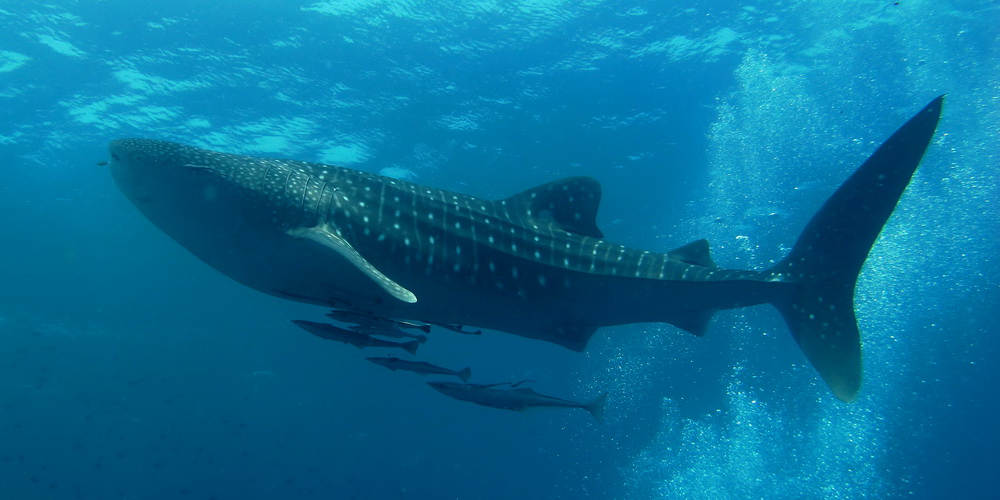
The Whale Shark is the largest fish in the world, yet despite its enormous size, this gentle giant feeds almost exclusively on plankton. Their distinctive spotted pattern is unique to each individual, like a fingerprint.
Max Size
40 feet (12 m), possibly up to 60 feet (18 m)
Lifespan
70-100 years
Depth
0-1,800 meters
Water Type
saltwater
Scientific Classification
- Class
- Chondrichthyes
- Order
- Orectolobiformes
- Family
- Rhincodontidae
- Species
- Rhincodon typus
Habitat & Distribution
Habitat
Distribution
Behavior
Whale sharks are docile filter feeders that pose no threat to humans. They often swim near the surface and tolerate divers swimming alongside them. They migrate thousands of miles following plankton blooms.
Reproduction
Whale sharks are ovoviviparous. A single female was found carrying 300 embryos at different developmental stages, suggesting they can store sperm and fertilize eggs over time.
Conservation Status
Main Threats
- Fishing
- Boat strikes
- Bycatch
- Fin trade
🎉 Fun Facts
- They are the largest non-mammalian vertebrate on Earth
- Each whale shark has a unique spot pattern
- They can filter 1,500 gallons of water per hour
- Despite 3,000 tiny teeth, they cannot bite or chew
- Females can carry up to 300 embryos